ASTER Token and the Aster DEX: A Complete Guide
-
 Written by
Rahul Nambiampurath
Written by
Rahul Nambiampurath - Updated 2026-02-06 14:38:19
The ASTER token is the native asset of the Aster decentralized exchange (DEX), a next-generation platform for perpetual and spot trading. Launched in 2025, Aster emerged from the merger of Astherus and APX Finance, combining expertise in multi-asset liquidity, perpetual derivatives, and yield-generating products. The project quickly attracted attention due to its ambitious roadmap, strong backing from YZi Labs (formerly Binance Labs), and public endorsement by Binance co-founder Changpeng Zhao (CZ).
It is important to distinguish ASTER from ASTR, the token of the Astar Network, which functions as a smart contract hub within the Polkadot ecosystem. ASTER powers the Aster DEX ecosystem, whereas ASTR supports Polkadot-based dApps and network governance. Confusing the two could lead to misdirected investment and missed exposure to Aster’s trading ecosystem
Table of content
Bridging Centralized and Decentralized Trading
Aster seeks to bridge the gap between centralized exchanges (CEXs) and DeFi. The platform offers advanced trading tools, including full order books, professional charting, and high-leverage trading up to 1001x, while emphasizing self-custody of assets.
The DEX supports both novice and professional traders through two interface modes. Simple Mode enables fast, one-click trade execution, while Pro Mode replicates the experience of a centralized exchange, with advanced order types and live market data. Aster aggregates liquidity across multiple chains, including BNB Chain, Ethereum, Solana, and Arbitrum, enabling seamless trading without the need for manual bridging.
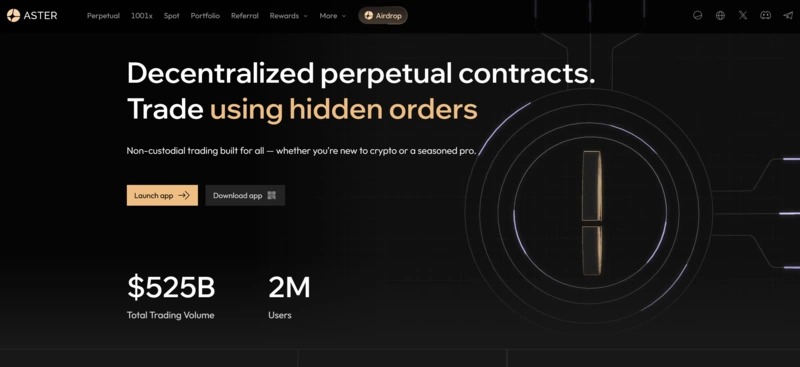
One of Aster’s key innovations is the ability to use yield-bearing assets as collateral. Traders can maintain open positions while simultaneously earning staking yield, creating dual returns, and improving capital efficiency. Additionally, the platform offers perpetual stocks, allowing 24/7 trading on major U.S. equities, such as Apple and Tesla, settled in USDT.
Privacy features like Hidden Orders protect traders from front-running and other blockchain-based exploits, ensuring a safer trading environment for all participants.
ASTER Tokenomics
The ASTER token has a maximum supply of 8 billion, designed to incentivize ecosystem growth, trading activity, and long-term engagement. More than half of the total supply is allocated to airdrops and rewards to bootstrap a large user base, while the remainder is reserved for the community, team, treasury, and liquidity provisions.
| Category | Token Amount | Percentage | Notes |
| Airdrops & Rewards | 4,280,000,000 | 53.5% | Linear release over 80 months after TGE |
| Ecosystem & Community | 2,400,000,000 | 30% | Grants, APX migration, marketing |
| Treasury | 560,000,000 | 7% | Reserved for strategic initiatives |
| Team | 400,000,000 | 5% | 1-year cliff, then linear over 40 months |
| Liquidity & Listing | 360,000,000 | 4.5% | Fully unlocked at TGE |
The token plays several roles within the ecosystem. Holders can participate in governance, staking, fee reductions, and premium features on the Aster platform. Staking not only reduces circulating supply but also provides long-term incentives, aligning the interests of traders, users, and the platform itself.
The large airdrop allocation accelerates adoption but introduces long-term inflationary pressure. For ASTER to maintain value, demand must consistently outpace new token supply, which is achieved through trading activity, staking rewards, and governance participation.
How Users Can Benefit
ASTER offers multiple avenues for potential value generation. Traders benefit from fee discounts, while staking rewards provide a way to earn yield. Active participants in the ecosystem can also benefit from airdrops and incentive programs, which reward trading activity, referrals, and holding positions.
Capital efficiency mechanisms allow users to leverage yield-generating collateral while trading, creating a dual stream of potential earnings. With the addition of stock perpetuals, traders gain exposure to traditional equities markets without leaving the blockchain, expanding opportunities for diversified strategies.
Launch Performance
ASTER’s launch on September 17, 2025, saw significant market activity. Starting at around $0.08–$0.09, the token surged to highs above $0.52, and in some cases $1.25, within the first few days. Early participants saw gains exceeding 1,600%, reflecting strong speculative interest.
Trading volume in the first 24 hours surpassed $1 billion, and the network added roughly 330,000 new wallet addresses. The platform’s Total Value Locked (TVL) jumped from $660 million to over $1 billion shortly after launch. Initially, ASTER was exclusive to the Aster DEX but later expanded to major centralized and decentralized exchanges, including Gate.io, MEXC, PancakeSwap, and Uniswap v3, increasing liquidity and accessibility.
Strategic Backing and Market Position
Aster’s rapid adoption was fueled by backing from YZi Labs and the public endorsement of CZ. This endorsement, often referred to as the “CZ halo effect,” provided instant credibility, marketing reach, and community trust. The project has been positioned as a direct competitor to Hyperliquid, the leading decentralized perpetuals platform. Its innovative features, multi-chain support, and institutional-level backing give it a clear opportunity to capture market share in a competitive DeFi space.
Roadmap and Team Plans
The Aster team has a clear strategic roadmap focusing on both technology and ecosystem growth. Aster plans to launch its own Layer 1 blockchain, known as Aster Chain, optimized for high-frequency trading and privacy using zero-knowledge proofs. Multi-chain liquidity aggregation will expand, ensuring seamless trading across BNB Chain, Ethereum, Solana, and Arbitrum.
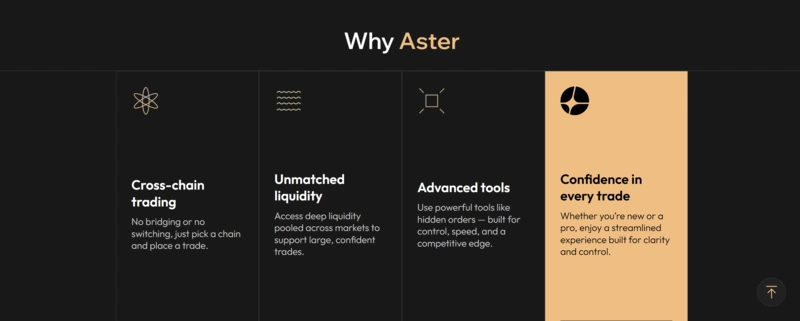
The platform also emphasizes institutional-grade liquidity solutions and professional trading tools to attract larger capital pools and professional traders. Gamified engagement through airdrop points and reward programs will continue, maintaining high trading activity and network growth. Strategic partnerships with PancakeSwap, Pendle, and ListaDAO aim to integrate liquidity and yield strategies across the DeFi ecosystem.
Risks and Considerations
Despite its advantages, Aster faces significant risks. Regulatory scrutiny is a key concern, particularly regarding high-leverage derivatives and stock perpetuals, which could attract attention from authorities such as the U.S. SEC.
Technical risks include the complexity of multi-chain smart contracts and potential vulnerabilities. Market volatility is expected due to early speculative trading, and the tokenomics model introduces long-term inflationary pressure from airdrops. Finally, reliance on CZ’s endorsement creates a concentration risk; any negative shift in perception could impact market confidence.
Conclusion
ASTER and the Aster DEX offer a comprehensive DeFi trading ecosystem that blends advanced trading tools with decentralized principles. Its dual-interface system, multi-chain liquidity, yield-bearing collateral, and stock perpetuals differentiate it from competitors. Strong backing from YZi Labs and CZ has accelerated adoption and provided early credibility.
The platform’s long-term success will depend on sustaining trading activity, maintaining liquidity, navigating regulatory pressures, and managing token supply effectively. ASTER provides multiple avenues for users to participate, earn rewards, and engage with the ecosystem, making it a compelling project for traders and investors seeking exposure to the decentralized perpetuals market.
By combining innovation, strategic partnerships, and an ambitious roadmap, Aster aims to become a leading decentralized perpetuals exchange, bridging the gap between traditional finance and DeFi.
We suggest trading ASTER on Bybit Exchange. Register here.